Sunday, 6 September 2015

Egypt's Mameluks vs. Mongols - THE BATTLE OF AIN JALUT SEPTEMBER 3, 1260 (755 years ago today)


Mongol Empire 1260.


AIN JALUT THE BATTLE OF AIN JALUT (AYN JALUT, IN ARABIC: عين جالوت, THE "SPRING/EYE OF GOLIATH" TOOK PLACE ON 3 SEPTEMBER 1260 BETWEEN MOSLEM MAMELUKS AND THE MONGOLS in the southeastern Galilee, in the Jezreel Valley, not far from the site of Zir'in. The battle marked the south-westernmost extent of Mongol conquests, and was the first time a Mongol advance had been permanently halted.

AIN JALUT SEPTEMBER 3, 1260 (755 years ago today)


Heading towards Egypt and Morocco, the last stronghold of the Moslems, the Mongol Houlagu Khan sent a threatening letter to the Emir of Egypt, “Al-Muzaffar Saif el Din Qutuz” (Arabic) "God has elevated Genghis Khan and his progeny and given us the realms of the face of the earth altogether. Everyone who has been recalcitrant in obeying us has been annihilated along with his women, children, kith and kin, towns, and servants. We have demolished the land, orphaned the children, tortured the people and slain them, made their honoured despised and their leader a captive. Do you think that you can escape from us? After a while you will know what's coming to you....


“If you are in submission to our court, send tribute, come yourself, and request a Shahna (royal pardon as an instrument of surrender) otherwise be prepared for battle."” However, the sudden death of the then-Khagan Möngke Khan; the brother of Houlagu, forced the Mongol Ilkhanate Houlagu Khan to take a large part of his army back with him on the way to Mongolia. He left his lieutenant, Kitbuga, with about 20,000 soldiers.


Mongol Warriors


KitBuga


But the Emir’s reply was to kill the 40 Mongolian delegation and leave their corpses hanging in his capital. He decided to meet the Mongols before the enemy reached Egypt. So they sent out an army in Palestine. Both Moslem and Mongol armies encamped in Palestine in July of 1260.


Mameluk Bahri Sultan Kutuz

He ruled only 1 year.


On the right Sultan Al Zahir
Baibars. He ruled 17 years.


When Kit Buqa heard of this, he ordered his troops to prepare for battle and commended them to "Stay where you are and wait for me." But before Kit Buqa arrived, Quduz attacked the Mongol advance guard and drove them to the banks of the Orontes. Kit Buqa, his zeal stirred, flared up like fire with all confidence in his own strength and might.

Mongol Lancers & Mounted Archers


The opposing forces met, both sides numbering about 20,000 men. The first to advance were the Mongols, whose force also included troops from the Kingdom of Georgia and about 1500 knights from the Armenian Kingdom of Cilicia, both of which had submitted to Mongol authority.

 
At the head Egypt’s Bahari Mamelukd was the Emir Al-Muzaffar Saif el-Dind Qutuz, aided by the powerful commander Baybars (El-Zahir Rukn el-Din Baibars al-Bunduqdari) who it is said had laid out the overall strategy of the battle since he had spent much time in that region, earlier in his life, as a fugitive. The two armies fought restlessly for many hours, with Mamlouk leader Baibars most of the time implementing hit-and-run tactics, in order to provoke the Mongol troops and at the same time preserve the bulk of his troops intact. When the Mongols carried out another heavy assault, Baibars and his men feigned a final retreat, drawing the Mongols into the highlands to be ambushed by the rest of the Mamlouk forces, who were concealed among the trees in the highlands.

Mameluk Archer's Training while another watches in full armor.


Representation of Sultan Kutuz spearing a Mongol.

The Mongol army and its leader KITBUGA fought very fiercely and very aggressively to break out, but the Mongols were pushed back and fled to the vicinity of Bisan followed by Qutuz's forces. There, they managed to rally and returned to the battlefield making a successful counterattack. However, the battle shifted in favor of the Mamlouks, who now had both the geographic and the psychological advantage, and eventually some of the Mongols were forced to retreat.

The Battle of Ain Jalut is also notable for being the earliest known battle where explosive hand cannons (madfa’a in Arabic) were used. These explosives were employed by the Mamlouk Egyptians in order to frighten the Mongol horses and cavalry and cause disorder in their ranks. The explosive gunpowder compositions of these cannon were later described in Arabic chemical and military manuals in the early 14th century


Mameluk Heavy Armored Cavalry


Notice the hand pistols (cannons) in its holsters      

The Mongols attacked, raining down arrows, and Quduz pulled a feint and started to withdraw. Emboldened, the Mongols rode out after him, killing many of the Egyptians, but when they came to the ambush spot, the trap was sprung from three sides. A bloody battle ensued, LASTING FROM DAWN TILL MIDDAY. The Mongols were powerless to resist, and in the end they were put to flight. Kit Buqa kept attacking left and right with all zeal. Some encouraged him to flee, but he refused to listen and said, "Death is inevitable. It is better to die with a good name than to flee in disgrace. In the end, someone from this army, old or young, will reach the court and report that Kit Buqa, not wanting to return in shame, gave his life in battle”.

When the battle ended, the Egyptian Mamlouk heavy cavalrymen had accomplished what had never been done before, BEATING THE MONGOLS IN CLOSE COMBAT. ALMOST THE WHOLE MONGOL ARMY, INCLUDING KITBUQA, WAS DESTROYED.


HISTORICAL IMPORTANCE OF AIN JALUT

THE BATTLE OF AIN JALUT saw a decisive victory of the Mamelukes of Egypt over the invading Mongols, which saved Egypt and Islam and halted the westward expansion of the Mongol empire. It was one of the most significant battles of world history - comparable to Marathon, Salamis, Lepanto, Chalons and Tours - in that it set the future course of both Islamic and western civilization.

Had the Mongols succeeded in conquering Egypt, they might have been able, following the return of Houlagu, to carry on across North Africa to the Straits of Gibraltar. Europe would have been surrounded from Poland to Spain. UNDER SUCH CIRCUMSTANCES, WOULD THE ISLAMIC CIVILIZATION HAVE FLOURISHED? WOULD THE EUROPEAN RENAISSANCE HAVE OCCURRED? ITS FOUNDATIONS WOULD CERTAINLY HAVE BEEN FAR WEAKER. THE WORLD TODAY MIGHT HAVE BEEN A CONSIDERABLY DIFFERENT PLACE.

                    
 Illustration of Rukh El Din Baibars, future Sultan of Egypt

AFTERMATH
On the way back to Cairo after the victory at Ain Jalut, Qutuz - a very brave & courageous Mameluk was assassinated by several emirs in a conspiracy led by Baibars. He was reinterred in Cairo and a Mosque is name after him.

Baibars (El-Zahir Rukn el-Din Baibars al-Bunduqdari) became the new Sultan.

His successors would go on to capture the last of the Crusader states in The Holy Land by 1291. The Mongols were again beaten at the First Battle of Homs less than a year later, and completely expelled from Syria.


BELLIGERANTS
 
 
MAMELUK    SULTANATE
1.      MAMELUKES
2.      Circassia’s Turks
3.      Egyptian infantry
MONGOL  EMPIRE
1.      MONGOLS
2.      Kingdom of Georgia
3.      Cilician (mercenaries)
4.      Armenia (mercenaries)
COMMANDERS & LEADERS
 
1.      SEIF EL DIN QUTUZ
2.      BAIBARS
COMMANDERS & LEADERS
 
1.      Ket Buga
UNITS INVOLVED
 
Light cavalry and horse archers & infantry
1.      Heavy cavalry Mamelukes
2.      Hand cannoneers
UNITS INVOLVED
 
Light cavalry and horse archers & infantry
1.      1500 Cilician Armenian troops
2.      1000 Georgian contingent
3.      Local Ayyubid contingents (Syrians)
4.      Uzbek Lancers
STRENGTH
18-20,000
STRENGTH
16-18,000
 
 LOSSES
1.      Heavy (9,000 est.)
 
LOSSES
1.      Near Complete
2.      Kit Buga (beheaded)

Historic Details
When the Sultan of Egypt Qutuz consulted with Baibars, his chief emir, in private: "My opinion," said Baibars, "is that we should kill the Mongol emissaries and ride as one to attack KitBuqa “ Win or die, in either case we will not be blamed, and we will have people’s gratitude." Quduz approved this plan, and by night he had the emissaries beheaded and stuck their heads on poles at the gates of his capital city Al Fustat (Cairo).

When Kit Buqa heard of this, he ordered his troops to prepare for battle and commended them to "Stay where you are and wait for me." But before Kit Buqa arrived, Quduz attacked the Mongol advance guard and drove them to the banks of the Orontes. Kit Buqa, his zeal stirred, flared up like fire with all confidence in his own strength and might. The two armies finally met at Ain Jalut on September 3, with both sides numbering about 20 000 men. The Mamelukes drew out the Mongol cavalry with a feigned retreat, and were almost unable to withstand the assault. Qutuz rallied his troops for a successful counterattack, along cavalry reserves hidden in the nearby valleys. Quduz had stationed his troops in ambush and, himself mounted with a few others, stood waiting. When the unsuspecting, Kit Buqa arrived with the main Mongol cavalry, Qutuz pounced on him clashed with him and his several thousand cavalry, all experienced warriors.
Qutuz, ordered Kitbuga’s head severed from his body and displayed to the retreating Mongol soldiers.

          _______________________________________

More Details.
After the battle of Ayn Jalut, the Moslem armies surged throughout Syria as far as the banks of the Euphrates, overthrowing everyone they found, plundering Kit Buqa’s camp, taking captive his wife, child, and retainers, and killing the tax collectors.

Only those Mongols who were warned escaped, and when the news of Ket Buqa Noyan’s death and his last words reached Houlagu Khan, he displayed his grief over his death and the fire of zeal flared up to avenge this defeat. But another Mongol invasion of the Moslem world was not to take place. Houlagu remained confined to the affairs of his homeland and could never bring himself to launch another invasion. After his death, the Mongol Golden Horde did rule the largest empire till then, that stretched from China to Muscovy (modern Moscow).

MONGOLS NEVER CAME AGAIN
A tendency that had started to gain hold among the Mongols was the creeping conversion to Islam. This was to put paid any further Mongol attempts to threaten Islamdom. Meanwhile the truculent Moslem armies did not stop at ejecting the Mongols from the Middle East, but they also give the final push to the Crusaders who were in occupation of Acre and Antioch, by capturing the last Crusader bastion in 1291.


By that time, most of the Mongols ultimately turned to Islam making Central Asia a Moslem land. (Uzbeks, Tajiks, Turkomans, Kazaks, Ughirs, Kirgiz, others).

NOW THE MOSLEMS DEFEATED THEIR ENEMIES ONE AFTER THE OTHER, AND BOTH THE MONGOLS AND CRUSADERS BECAME HISTORY IN THE MIDDLE EAST.


Video reconstruction of the battle.

http://www.youtube.com/watch?v=GGPffMycJec


More Notes On Sultan Baibars

Baibars or Baybars (Arabic: الملك الظاهر ركن الدين بيبرس البندقداري‎, al-Malik al-Ẓāhir Rukn al-Din Baibars al-Bunduqdari), nicknamed Abu l-FutuhBaibars or Baybars (Arabic: الملك الظاهر ركن الدين بيبرس البندقداري‎, defeated the crusaders in THREE CAMPAIGNS.  In order to support his military campaigns, Baibars commissioned arsenals, warships and cargo vessels. He was also arguably the first to employ EXPLOSIVE HAND CANNONS IN WAR, at the Battle of Ain Jalut. His military campaign also extended into Libya and Nubia.
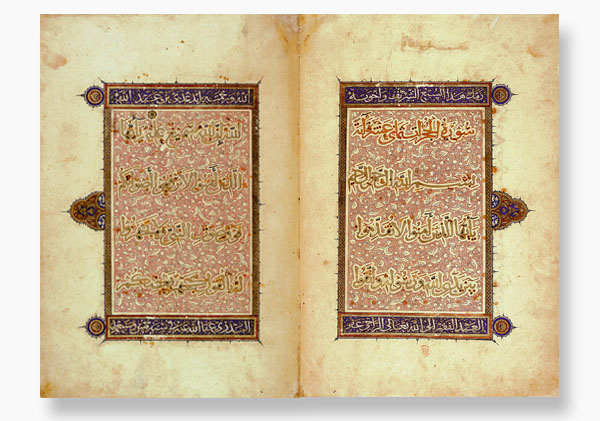
Baibars 13th century magnificent (illuminure) KORAN - British Museum.

POST SCRIPTUM
His memoirs were recorded in Sirat al-Zahir Baibars ("Life of al-Zahir Baibars"), a popular Arabic romance recording his battles and achievements. He has a heroic status in Kazakhstan, as well as in Egypt and Syria. Al-Madrassa al-Zahiriyya is the school built adjacent to his Mausoleum in Damascus. The Az-Zahiriyah library has a wealth of manuscripts in various branches of knowledge to this day. The library and Mausoleum are being reconstructed by Kazakhstan government fund.

In 2009, a copy of Sultan Beibars Mausoleum in Damascus was to be built in Kazakhstan.


The Bahri Mameluk Empire 1325                          


Saturday, 29 August 2015

EXPLAINING THEIR IGNORANCE, NOT TO MENTION INDOCTRINATION BY SAYING "YOU WERE RIGHT MICHAEL, BUT WE WERE NEVER TAUGHT THIS" DOESN'T CUT IT. IT IS NO EXCUSE, ESPECIALLY FROM UNIVERSITY FACULTY MEMBERS.


Read and reread...learn the names of Arabic Scholars, their inventions...and how they changed the world...be proud of our heritage.


Before you read, let me state that knowledge is cumulative and no one civilization has the monopoly of everything we know, whether it is objects or thoughts. As such, for years, I have been profoundly disturbed by the half-truths and false evidences which were taught in the Western world for so many generations. In fact, the West has purposely either ignored or belittle (in no small parts due to the 50 year fabrication and junk coming out of Hollywood – a Zionist monopoly) the immense contributions and innovations of the Moslem world during the crucial developmental era in the Middle Age between the 9th and 13th centuries, which led to the Renaissance.

There is a gap, a hole in most Western’s students’ knowledge… they leap frog from the Greeks and Romans to the Renaissance, ignoring a period of 500 years; the period of the glory of the Moslem Arab civilization in Spain, Sicily, Sardinia and North Africa, a civilization which far surpassed in every field anything existing in Western Europe at the time.
The majority of Europeans still are largely unaware of the immense debt they owe to the translation era (which lasted 200 years) of the manuscripts & books in medicine, mathematics, chemistry, architecture, town planning, botany, astronomy, philosophy and theology by Moslem Arab Scholars (refer to the statements of modern historians – Arnold Toynbee, Marguerite Yourcenar, others).

                   __________________________________

 NOW READ

How Islamic inventors changed the world


From coffee to How Islamic inventors changed the world and the cheques and the three-course meal, the Moslem world has given the WEST many innovations that we take for granted in daily life. As a new exhibition opens, Paul Vallely nominates 20 of the most influential- and identifies the men of genius behind it.


1.The story goes that a man named Khalid (though he may have been an Ethiopian Copt, one thing is certain he spoke Arabic) was tending his goats in the Kaffa region of southern Ethiopia, when he noticed his animals became livelier after eating a certain berry. He boiled the berries to make the first coffee. Certainly the first record of the drink is of beans exported from Ethiopia to Yemen where Sufis drank it to stay awake all night to pray on special occasions. By the late 15th century it had arrived in Mecca and Turkey from where it made its way to Venice in 1645. It was brought to England in 1650 by a Turk named Pasqua Rosee who opened the first coffee house in Lombard Street in the City of London. The Arabic qahwa became the Turkish kahve then the Italian caffé and then English coffee. عمدة الصفوة في حل القهوة


2. The ancient Greeks thought our eyes emitted rays, like a laser, which enabled us to see. The first person to realise that light enters the eye, rather than leaving it, was the 10th-century Moslem mathematician, astronomer and physicist Ibn al-Haitham. He invented the first pin-hole camera after noticing the way light came through a hole in window shutters. The smaller the hole, the better the picture, he worked out, and set up the first Camera Obscura (from the Arab word qamara for a dark or private room). He is also credited with being the first man to shift physics from a philosophical activity to an experimental one.
Ibn Al Haitham theorem


3. A form of chess was played in ancient India but the game was developed into the form we know it today in Persia. From there it spread westward to Europe - where it was introduced by the Moors in Spain in the 10th century - and eastward as far as Japan. The word rook comes from the Persian rukh, which means chariot. Chess passed from Persia to the Arab world, where its name changed to Arabic shatranj. From there it passed to Western Europe. Shatranj made its way via the expanding Islamic Arabian empire to Europe.


4. A thousand years before the Wright brothers a Moslem poet, astronomer, musician and engineer named Abbas ibn Firnas made several attempts to construct a flying machine. Abbas ibn Firnas (810–887 A.D.), also known as Abbas Abu al-Qasim ibn Firnas ibn Wirdas al-Takurini (Arabic: عباس بن فرناس), was an Andalusian polymath In 852 he jumped from the minaret of the Grand Mosque in Cordoba using a loose cloak stiffened with wooden struts. He hoped to glide like a bird. He didn't. But the cloak slowed his fall, creating what is thought to be the first parachute, and leaving him with only minor injuries. In 875, aged 70, having perfected a machine of silk and eagles' feathers he tried again, jumping from a mountain. He flew to a significant height and stayed aloft for ten minutes but crashed on landing - concluding, correctly, that it was because he had not given his device a tail so it would stall on landing. Baghdad international airport and a crater on the Moon are named after him.


5. Washing and bathing are religious requirements for Moslems, which is perhaps why they perfected the recipe for soap which we still use today. The ancient Egyptians had soap of a kind, as did the Romans who used it more as pomade. But it was the Arabs who combined vegetable oils with sodium hydroxide and aromatics such as thyme oil. One of the Crusaders' most striking characteristics, to Arab nostrils, was that they did not wash. Shampoo was introduced to England by a Moslem who opened Mahomed's Indian Vapour Baths on Brighton seafront in 1759 and was appointed Shampooing Surgeon to Kings George IV and William IV.


6. Distillation, the means of separating liquids through differences in their boiling points, was invented around the year 800 by Islam's foremost scientist, Jabir ibn Hayyan, who transformed alchemy into chemistry, inventing many of the basic processes and apparatus still in use today - liquefaction, crystallisation, distillation, purification, oxidisation, evaporation and filtration. As well as discovering sulphuric and nitric acid, he invented the alembic still, giving the world intense rosewater and other perfumes and alcoholic spirits (although drinking them is haram, or forbidden, in Islam). Ibn Hayyan emphasised systematic experimentation and was the founder of modern chemistry. He is in fact universally considered as the FATHER OF CHEMISTRY.


15th-century European portrait of "Geber", Codici Ashburnhamiani 1166, Biblioteca Medicea Laurenziana, Florence


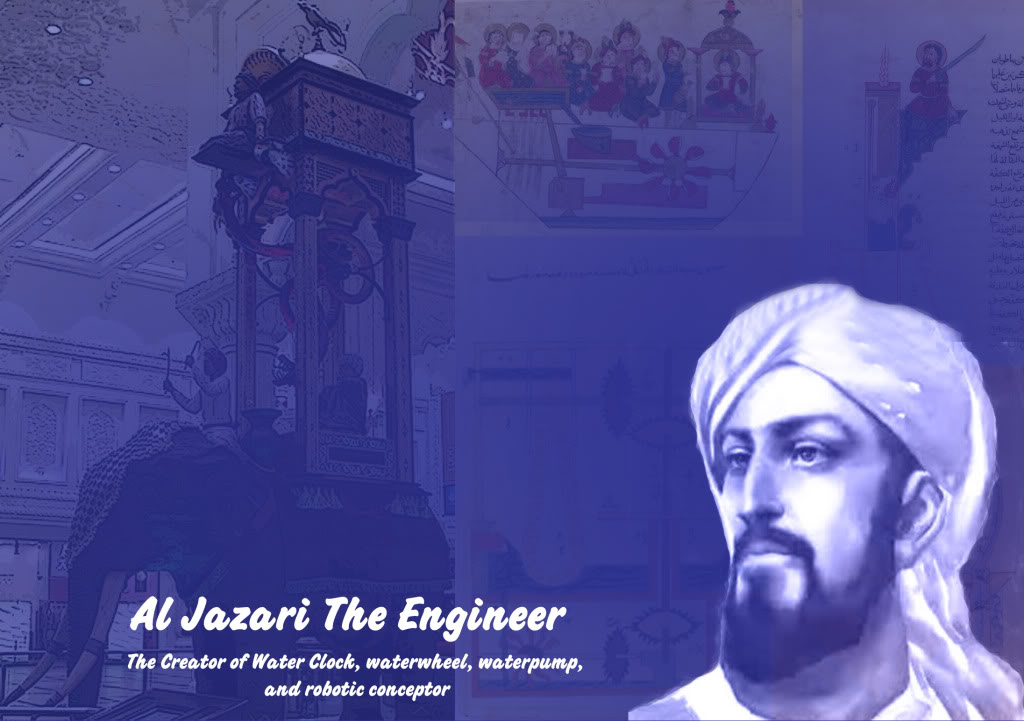
 7. The crank-shaft is a device which translates rotary into linear motion and is central to much of the machinery in the modern world, not least the internal combustion engine. One of the most important mechanical inventions in the history of humankind, it was created by an ingenious Moslem engineer called al-Jazari to raise water for irrigation. He is best known for writing the al-Jāmiʿ bain al-ʿilm wa al-ʿamal al-nāfiʿ fī ṣināʿat al-ḥiyal (The Book of Knowledge of Ingenious Mechanical Devices) in 1206, where he described 100 mechanical devices, some 80 of which are trick vessels of various kinds, along with instructions on how to construct them. His 1206 Book of Knowledge of Ingenious Mechanical Devices shows he also invented or refined the use of valves and pistons, devised some of the first mechanical clocks driven by water and weights, and was the father of robotics. Among his 50 other inventions was the combination lock.


Robotic musical box with players


8. Quilting is a method of sewing or tying two layers of cloth with a layer of insulating material in between. It is not clear whether it was invented in the Moslem world or whether it was imported there from India or China. But it certainly came to the West via the Crusaders. They saw it used by Saracen warriors, who wore straw-filled quilted canvas shirts instead of armour. As well as a form of protection, it proved an effective guard against the chafing of the Crusaders' metal armour and was an effective form of insulation - so much so that it became a cottage industry back home in colder climates such as Britain and Holland.


9. The pointed arch so characteristic of Europe's Gothic cathedrals was an invention borrowed from Islamic architecture. It was much stronger than the rounded arch used by the Romans and Normans, thus allowing the building of bigger, higher, more complex and grander buildings. Other borrowings from Moslem genius included ribbed vaulting, rose windows and dome-building techniques. Europe's castles were also adapted to copy the Islamic world's - with arrow slits, battlements, a barbican and parapets. Square towers and keeps gave way to more easily defended round ones. Henry V's castle architect was a Moslem.


10 Many modern surgical instruments are of exactly the same design as those devised in the 10th century by a Moslem surgeon called al-Zahrawi,  Abu al-Qasim al-Zahrawi (936-1013) known also by his Latin name Albucasis. His scalpels, bone saws, forceps, fine scissors for eye surgery and many of the 200 instruments he devised are recognisable to a modern surgeon. It was he who discovered that catgut used for internal stitches dissolves away naturally (a discovery he made when his monkey ate his lute strings) and that it can be also used to make medicine capsules. In the 13th century, another Moslem medic named Ibn Nafis described the circulation of the blood, 300 years before William Harvey discovered it. Moslems doctors also invented anaesthetics of opium and alcohol mixes and developed hollow needles to suck cataracts from eyes in a technique still used today.


Abu Al-Qasim surgical instruments


Latin name ALBUCASIS


  11. The windmill was invented in 634 by Abu Ishaq Ibrahim ibn Muhammad al-Farisi al Istakhri (aka Estakhri, Persian: استخری‎, i.e. from the Iranian city of Estakhr, 11. The windmill was invented in 634 by Abu Ishaq Ibrahim ibn Muhammad al-Farisi al Istakhri (aka Estakhri, Persian: استخری‎, i.e. from the Iranian city of Estakhrb. - d. 957 AD for a Persian caliph and was used to grind corn and draw up water for irrigation. In the vast deserts of Arabia, when the seasonal streams ran dry, the only source of power was the wind which blew steadily from one direction for months. Mills had six or 12 sails covered in fabric or palm leaves. It was 500 years before the first windmill was seen in Europe.


12. The technique of inoculation was not invented by Jenner and Pasteur but was devised in the Moslem world and brought to Europe from Turkey by the wife of the English ambassador to Istanbul in 1724. The practice was introduced to England by Lady Mary Wortley Montagu. Lady Montagu's husband, Edward Wortley Montagu, served as the British ambassador to the Ottoman Empire from 1716 to 1718. She witnessed firsthand the Turkish use of inoculation in Istanbul and was greatly impressed. The Turkish practice was presented to the Royal Society in 1714 and 1716, when the physicians Emanuel Timoni and Giacomo Pylarini independently sent letters from Constantinople. Children in Turkey were vaccinated with cowpox to fight the deadly smallpox at least 50 years before the West discovered it.


13. The first fountain pen was made in In 953, Ma'ād al-Mu'izz, the caliph of Egypt, demanded a pen which would not stain his hands or clothes, and was provided with a pen which held ink in a reservoir and delivered it to the nib via gravity and capillary action. The fountain pen was invented for the Sultan of Egypt in 953. It held ink in a reservoir and, as with modern pens, fed ink to the nib by a combination of gravity and capillary action.


14. The system of numbering in use all round the world is probably Indian in origin but the style of the numerals is Arabic and first appears in print in the work of the Moslem mathematicians al-Khwarizmi and al-Kindi around 825. Algebra was named after al-Khwarizmi's book, Al-Jabr wa-al-Muqabilah, much of whose contents are still in use. Al-Khwārizmī's contributions to mathematics, geography, astronomy, and cartography established the basis for innovation in algebra and trigonometry. His systematic approach to solving linear and quadratic equations led to algebra, a word derived from the title of his 830 book on the subject, "The Compendious Book on Calculation by Completion and Balancing".


A stamp issued September 6, 1983 in the Soviet Union, commemorating al-Khwārizmī's (approximate) 1200th birthday.


On the Calculation with Hindu Numerals written about 825, was principally responsible for spreading the Hindu–Arabic numeral system throughout the Middle East and Europe. It was translated into Latin as Algoritmi de numero Indorum. Al-Khwārizmī, rendered as (Latin) Algoritmi, led to the term "algorithm".The work of Moslem maths scholars was imported into Europe 300 years later by the Italian mathematician Fibonacci. Algorithms and much of the theory of trigonometry came from the Moslem world. And Al-Kindi's discovery of frequency analysis rendered all the codes of the ancient world soluble and created the basis of modern cryptology.


The original Arabic print manuscript of the Book of Algebra by Al-Khwārizmī.


15. Abu l-Hasan ‘Ali Ibn Nafi(789-857), Kurdish: Abu'l Hesen 'Elî ibn Nafî (Ziryab), Arabic: أبو الحسن علي ابن نافع, Persian: زریاب) was a Kurdish musician, singer, oud player, composer, poet and teacher, who lived and worked in Iran, Iraq, Northern Africa and during more than 30 years, in Andalus of the medieval Islamic period. He was also known as a polymath, with knowledge in astronomy, geography, meteorology, botanics, cosmetics, culinary art and fashion. Ali ibn Nafi, known by his nickname of Ziryab (Blackbird) came from Iraq to Cordoba in the 9th century and brought with him the concept of the three-course meal - soup, followed by fish or meat, then fruit and nuts. He also introduced crystal glasses (which had been invented after experiments with rock crystal by Abbas ibn Firnas) as a container for drinks, which was more effective than metal.


16. Carpets were regarded as part of Paradise by medieval Moslems, thanks to their advanced weaving techniques, new tinctures from Islamic chemistry and highly developed sense of pattern and arabesque which were the basis of Islam's non-representational art. In contrast, Europe's floors were distinctly earthly, not to say earthy, until Arabian and Persian carpets were introduced. In England, as Erasmus recorded, floors were "covered in rushes, occasionally renewed, but so imperfectly that the bottom layer is left undisturbed, sometimes for 20 years, harbouring expectoration, vomiting, the leakage of dogs and men, ale droppings, scraps of fish, and other abominations not fit to be mentioned". Carpets, unsurprisingly, caught on quickly.


17. The modern cheque comes from the Arabic saqq, a written vow to pay for goods when they were delivered, to avoid money having to be transported across dangerous terrain. Moslem traders are known to have used the cheque or ṣakk system since the time of Harun al-Rashid (9th century) of the Abbasid Caliphate. Transporting a paper saqq was more secure than transporting money. In the 9th century, a merchant in country A could cash a saqq drawn on his bank in country B.[9] In the 9th century, a Moslem businessman could cash a cheque in China drawn on his bank in Baghdad.


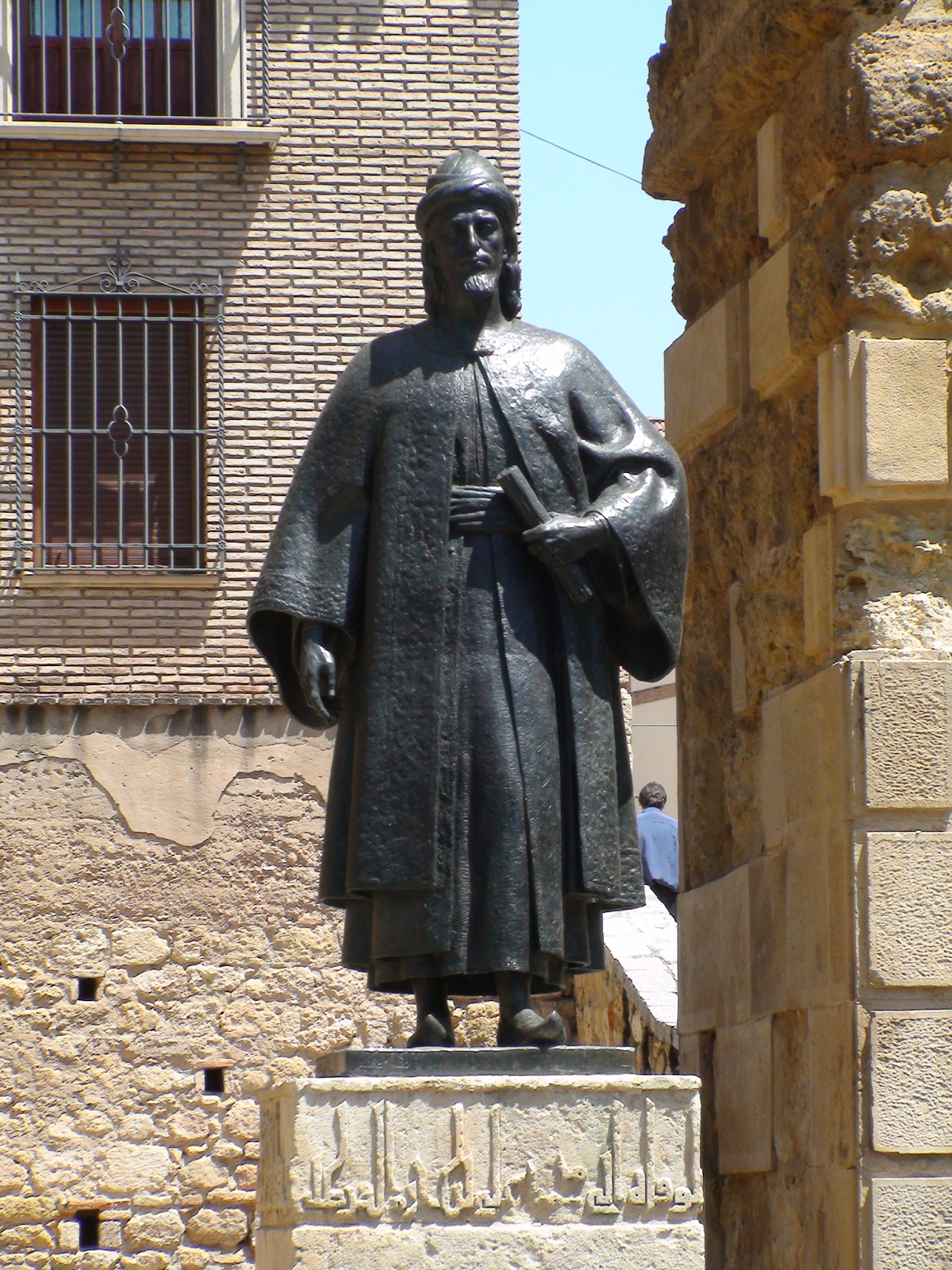
18. By the 9th century, many Moslem scholars took it for granted that the Earth was a sphere. The proof, said astronomer Ibn Hazm, "is that the Sun is always vertical to a particular spot on Earth". Abū Muḥammad ʿAlī ibn Aḥmad ibn Saʿīd ibn Ḥazm (Arabic: أبو محمد علي بن احمد بن سعيد بن حزم‎; also sometimes known as al-Andalusī aẓ-Ẓāhirī; November 7, 994 – August 15, 1064 was an Andalusian polymath born in Córdoba, present-day Spain. He was a leading proponent and codifier of the Zahiri School of Islamic thought, and produced a reported 400 works of which only 40 still survive, covering a range of topics such as Islamic jurisprudence, history, ethics, comparative religion, and theology, as well as The Ring of the Dove, on the art of love. The Encyclopaedia of Islam refers to him as having been one of the leading thinkers of the Moslem world, and he is widely acknowledged as the father of comparative religious studies. It was 500 years before that realisation dawned on Galileo. The calculations of Moslem astronomers were so accurate that in the 9th century they reckoned the Earth's circumference to be 40,253.4km - less than 200km out. The scholar al-Idrisi took a globe depicting the world to the court of King Roger of Sicily in 1139.


IBN HAZM STATUE IN CORDOBA
19. Though the Chinese invented saltpetre gunpowder, and used it in their fireworks, it was the Arabs who worked out that it could be purified using potassium nitrate for military use. In the 13th century a Syrian scholar, Hassan Al-Rammah (d. 1294-1295), wrote a remarkable book on military technology, which became very famous in the west. The first documented rocket is included in the book, a model of which is exhibited at the National Air and Space Museum in Washington D.C.  Hasan al-Rammah included 107 gunpowder recipes in his al-furusiyyah wa al-manasib al-harbiyya (The Book of Military Horsemanship and Ingenious War Devices), 22 of which are for rockets. If one takes the median of 17 of these 22 compositions for rockets (75% nitrates, 9.06% sulphur and 15.94% carbon), it is almost identical with the reported ideal recipe (75% potassium nitrate, 10% sulphur, and 15% carbon).

Hasan al-Rammah also describes the purifying of saltpeter using the chemical processes of solution and crystallization. This was the first clear method for the purification of saltpeter. The earliest torpedo was also first described in 1270 by Hasan al-Rammah in The Book of Military Horsemanship and Ingenious War Devices, which illustrated a torpedo running with a rocket system filled with explosive materials and having three firing points Moslem incendiary devices terrified the Crusaders. By the 15th century they had invented both a rocket, which they called a "self-moving and combusting egg", and a torpedo - a self-propelled pear-shaped bomb with a spear at the front which impaled itself in enemy ships and then blew up. Guns were being used by Arabs in 1340AD in the defence of Al-Bashur, when under siege by Franzdol. In Khans book Arab Civilization, he writes


“Gunpowder was a great invention of the Arabs, who were already using guns”.


20. Medieval Europe had kitchen and herb gardens, but it was the Arabs who developed the idea of the garden as a place of beauty and meditation. The first royal pleasure gardens in Europe were opened in 11th-century Moslem Spain. Flowers which originated in Moslem gardens include the carnation and the tulip.

                           ______________________________________
https://www.google.com/search?sourceid=navclient&aq=&oq=1001+inventions&ie=UTF-8&rlz=1T4LENN_en___CA509&q=1001+inventions+that+changed+the+world&gs_l=hp..3.0l5.0.0.11.1259692...........0._7SJFdx3iww


"1001 Inventions: Discover the Moslem Heritage in Our World" is a new exhibition which began a nationwide tour this week. It is currently at the Science Museum in Manchester. For more information, go to


     (Put cursor, Press control and Click) AND


                      ____________________________________

Think of the origins of camera of modern life, the cup of coffee, and Oxford university of England to mind. But in fact, Yemen is where the coffee was first brewed has its true origins. Even the toothbrush is among the surprising Moslem inventions that have shaped the world we live in today.


exterior of al-Karaouine University (Arabic: جامعة القرويين‎) AL KARAOUN in Fez), founded in 859

Along with the first university al-Qarawiyyin or al-Karaouine (Arabic: جامعة القرويين‎) AL KARAOUN in Fez), founded in 859,  according to UNESCO and Guinness World Records and is sometimes referred to as the oldest university in the world. The Famous Al Azhar university in Cairo was founded in 970. By contrast the first university in the Western world was the university of Paris (1250) founded 400 years later.

 ________________________________

The origins of these fundamental ideas and objects – the basis of everything from the bicycle to musical scales – are the focus of “1001 Inventions,” a book celebrating “the forgotten” history of 1,000 years of Moslem heritage.


“1001 Inventions” is now an exhibition at London’s Science Museum. It is hoped that the exhibition will highlight the contributions of non-Western cultures – like the Moslem empire that once covered Spain and Portugal, Southern Italy and stretched as far as parts of China – to present day civilization.

                        ________________________________________________

EPILOGUE 1

 The question is: What happened to the brilliant Moslem Arab civilization? Answer: Two things happened, 2 catastrophes:


1.    BAGHDAD BURNED FOR 7 DAYS.

The destruction & burning of Baghdad by Khan Houlagu (whose name is the origin of the word Hooligan).


The Mongols sacked the city in 1258. After a 6 months siege, the Mongols captured the city, put to the sword ½ the estimated 1 million population and burned ½ the manuscripts & books in the great Library of Baghdad …, (Though Houlagu was a grandson of Genghis Khan, the irony is that 3 of Genghis Khan’s sons & their descendants embraced ISLAM: a) TAMERLAN – Timur ling - whose real name was Emir Hassan ibn Muhammad Taraghai and b) Abdullah II the last King of Mongolia who abdicated in 1920).

2.     OTTOMANS CONQUEST

The Ottoman’s conquest in 1515 of the entire Middle East (from Tunis to Baghdad) by the Ottoman Sultan Selim II was a death sentence. When he retreated to Istanbul, Sultan Selim II took with him an estimated 30,000 Arab Scientists, Calligraphers, Doctors, Astrologists, Town Planners, Mathematicians, Craftsmen from Cairo, Baghdad and Damascus, leaving behind only the 12-13 year olds apprentices. After that, the voice of Moslem Arab was silenced for more than 4 centuries (until 1918); though the official language of the Ottoman Empire was formal Arabic, neither the occupying troops nor the common Turks spoke Arabic. In addition, the ruling vassal dynasties in Tunisia, Libya and Egypt were foreign dynasties (Turco-Albanians).
       _______________________________

EPILOGUE 2

No matter how much ignorant & indoctrinated Westerners may try to belittle modern Arabs and have them feel inferiors, such attempt will fail... Why? Because most Arab university graduates KNOW how much indebted the Western world owes to the innovations and contributions of the once great & brilliant Moslem Arab civilization during the Middle Age. In fact the historian Arnold Toynbee and Marguerite Yourcenar (Marguerite de Grayencour), winner of the Prix Femina and the Erasmus Prize, who was the first woman elected to the Académie Française, in 1980 stated officially: (here, I am paraphrasing)


"where it not for the translation in Moslem Spain in the 11-12th centuries of the Arabic manuscripts & books of the immense contributions & innovations made by the Moslem Arab civilization in medicine, mathematics, astrology, town planning, architecture, philosophy and theology; the Middle Age in Europe would have lasted a further 300 years, most probably until the 16th century”.
 

In short, they both said that the RENAISSANCE – Il RINASCIMENTO - was in great part due to the translation of Arabic manuscripts.


Remark: After the fall of the kingdom of Grenada, the last Arab Moorish possession in Spain in 1492, the dreaded and horrific Catholic Inquisition started whose purpose was to eradicate Islam & Judaism in Spain … but a little known reason is the fact that thousands of Spanish families at the time were teaching their children ARABIC secretly as they considered ARABIC the language of SCIENCE.

            
THE SAME IN SICILY UNDER

Abdel Rahman III King of Sicily

                     _____________________________________


In the year 1000 CE (Common Era), the Arab University of Cordoba had more than 400,000 manuscripts & books (more than the combined books existing in UK, France & Italy)…and there were 19 other Arabic universities in Andalusia (Salamanca, Coimbra, Valencia, Alhambra, etc.).

                        __________________________

NOTE 2

I have always maintained that Greece is mostly an invention of 19th century romantic historians who covertly wished that the beginning of European history would start geographically and philosophically in an area located in WESTERN EUROPE. The truth is that the Greeks invented quasi-nothing … everything had been already discovered by the ancient Egyptians and Persians... and the Greeks knew it through their contact with the CRETAN (isle of Crete) civilization.

Let's take one example of misinformation:

The Father of Medicine was the Egyptian IMHOTEP not Hyppocrates

Imhotep was the first known physician, medical professor and a prodigious writer of medical books. As the first medical professor, Imhotep is believed to have been the author of the Edwin Smith Papyrus in which more than 90 anatomical terms and 48 injuries are described. He also founded a school of medicine in Memphis, possibly known as “Asklepion, which remained famous for two thousand years. All of this occurred some 2,200 years before the Western Father of Medicine Hippocrates was born.
The medical history books will have to be revised, says Roger Highfield
The Egyptian Imhotep (2667 - 2648 BCE) is the first physician in history known by name. The earliest known surgery in Egypt was performed in Egypt around 2750 BCE. The Kahun Gynaecological Papyrus treats women's complaints, including problems with conception. Thirty four cases detailing diagnosis and treatment survive, some of them fragmentarily. Dating to 1800 BCE, it is the oldest surviving medical text of any kind. Imhotep lived during the Third Dynasty at the court of King Zoser. Imhotep was a known scribe, chief lector, priest, architect, astronomer and magician (medicine and magic fell under this category.) For 3000 YEARS HE WAS WORSHIPPED AS A GOD IN GREECE AND ROME.  WHEN THE GREEKS CONQUERED EGYPT THEY RECOGNIZED IN HIS CONTRIBUTIONS AND ADOPTED HIS METHODOLOGIES IN THEIR MEDICINE, AND CONTINUED TO BUILD TEMPLES TO HIM.  


The Edwin Smith papyrus, the world’s oldest surviving surgical document. Written in hieratic script in ancient Egypt around 1600 B.C., the text describes anatomical observations and the examination, diagnosis, treatment, and prognosis of 48 types of medical problems in exquisite detail.


______________________________

P.S.
Cases in point showing both ignorance and indoctrination among modern faculty members.


 IBN SINNA


Twenty five years ago, I was sitting at a table in the university library doing some research, when Dr. … (name withheld, though he is probably dead now) came and sat down facing me. He was an establish author, a medievalist and Professor Emeritus at U of T. I recognized him and saw that he was reading a book on AVICENNA. “Hi Dr., I am sure you know the full name of AVICENNA, the greatest medieval Universalist” … he replied “I don’t remember his name, but he was a Jewish scholar”!! 
I was astonished by his ignorance and indoctrination, however, in deference to his age, I choose irony “well, he must have been a very unusual Jew, since his name is Abū ʿAlī al-Ḥusayn ibn ʿAbd Allāh ibn Sīnā … Avicenna is his latinized name, Dr. Professor Emeritus”. 

Shortly after, he got up and sat at another table ... THE CRETIN !!


Ibn SINNA


Arabic: أبو علي الحسين ابن عبد الله ابن سينا;  c. 980 – June 1037 was a Persian polymath and jurist who is regarded as one of the most significant thinkers and writers of the Islamic Golden Age. Of the 450 works he is known to have written, around 240 have survived, including 150 on philosophy and 40 on medicine.
His most famous works are THE BOOK OF HEALING – a philosophical and scientific encyclopedia, and THE CANON OF MEDICINE – a medical encyclopedia, which became a standard medical text at many medieval universities and remained in use as late as 1650. His description & graphics of the disease of the eye remained the standard reference book at the school of medicine in VIENNA as late as 1790.


Ibn Sina the greatest Universalist.


ANOTHER  CASE OF WESTERN IGNORANCE BY UNIVERSITY TENURED PROFESSORS -- I WAS VERY BRUTAL ( I CALLED SOME CRETINS)


 IBN RUSHD

IBN RUSHD Latinised as Averroes


 Averroës, medieval Latin Averrhoës, also called Ibn Rushd, Arabic in full Abū al-Walīd Muḥammad ibn Aḥmad ibn Muḥammad ibn Rushd    (born 1126, Córdoba [Spain]—died 1198, Marrakech, influential Islamic religious philosopher who integrated Islamic traditions with ancient Greek thought. At the request of the Almohad caliph Abu Yaʿqub Yusuf, he produced a series of summaries and commentaries on most of Aristotle’s works (1169–95) and on Plato’s Republic, which exerted considerable influence in both the Islamic world and Europe for centuries. He wrote the Decisive Treatise on the Agreement Between Religious Law and Philosophy (Faṣl al-Maḳāl), Examination of the Methods of Proof Concerning the Doctrines of Religion (Kashf al-Manāhij), and The Incoherence of the Incoherence (Tahāfut al-Tahāfut), all in defense of the philosophical study of religion against the theologians (1179–80). Regarding his studies in astronomy, Averroes argued for a strictly concentric model of the universe, and explained sunspots and scientific reasoning regarding the occasional opaque colors of the moon. He also worked on the description of the spheres, and movement of the spheres.


IBN RUCHD/RUSHD PLAQUE IN CORDOBA (SPAIN)


When I asked some acquaintances or part-time colleagues (university lecturers & assistant professors) if they knew who AVERROES was, the reply was that he was an Italian/French medieval scientist!! I confess that my reaction was very brutally worded (it usually is when confronted by the ignorance of Faculty members) … In truth, a few took the trouble to go to the main library …then returned & apologized by saying “You were right Michael, but we were never taught this” … which is precisely the shameful gap, the hole about non-Western civilization I mentioned in my preamble. I have no doubt in my mind that the main culprit for neglecting, omitting and dismissing purposely the Moslem Arab immense contributions was the Catholic Church who during the 2 centuries of translation instructed the translators monks to choose the Greek words when they existed … Arabic words were used only when there were no equivalent e.g. (alcohol, algebra, camphor, compass, admiral, alcove, apricot, giraffe, caliber, zero, etc.)

 AND ANOTHER

IBN BATUTAH


Ibn Baṭūṭah (/ˌɪbənbætˈtuːtɑː/ Arabic: أبو عبد الله محمد بن عبد الله اللواتي الطنجي بن بطوطة‎, ʾAbū ʿAbd al-Lāh Muḥammad ibn ʿAbd al-Lāh l-Lawātī ṭ-Ṭanǧī ibn Baṭūṭah), or simply Muhammad Ibn Battuta (ابن بطوطة) (February 25, 1304 – 1368 or 1369), was a Moroccan explorer of Berber descent, who is widely recognised as one of the greatest travelers of all time. He is known for his extensive travels, accounts of which were published in the Rihla (lit. "Journey"). Over a period of thirty years, Ibn Battuta visited most of the known Islamic world as well as many non-Moslem lands. His journeys included trips to North Africa, the Horn of Africa, West Africa and Eastern Europe, and to the Middle East, South Asia, Central Asia, Southeast Asia and China.


Ibn Battutta covered 120,000 klm, that is 3 times the earth’s circumference; compared to his periple, Marco Polo's trip to China and back to Venice could be described as a mere Sunday Stroll.